The light goes right as the episode reaches the good part. You wait a minute, because it always comes back. Somewhere down the street, someone shouts “NEPA!” in disappointment. Then the generator starts, and you do the quiet arithmetic of what tonight’s fuel is going to cost.
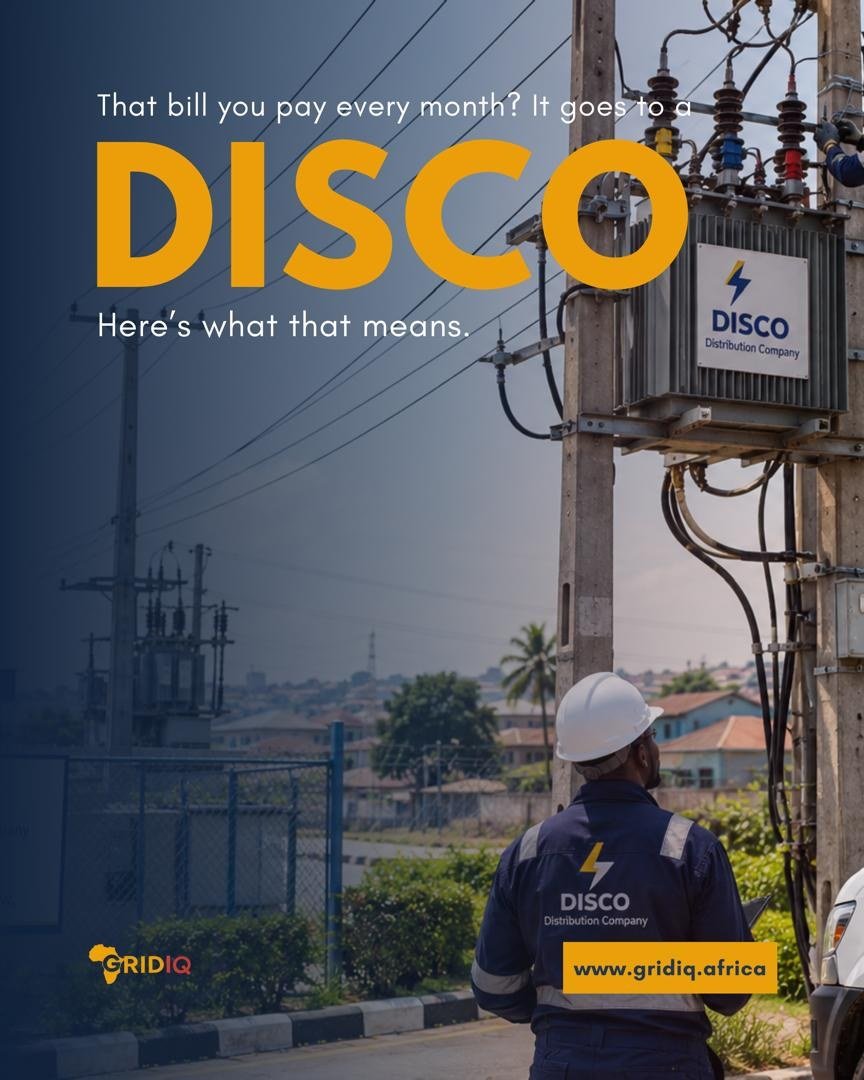
A few days later your bill or token message arrives, and you are sure of one thing: it is the DisCo’s fault. But what does that company actually do between the power station and your socket, and what is it really responsible for? Most of us have never been told.
Where DisCos sit in the chain
GenCos produce power. The Transmission Company of Nigeria (TCN) carries it across the high-voltage grid. The DisCo takes over at the transmission substation. From that handover, everything is the DisCo’s job: stepping the voltage down, moving power through 33kV and 11kV feeders and distribution transformers, and delivering it on the low-voltage lines that reach homes and businesses.
- GenCosProduce the power
- TCNCarries it across the high-voltage grid
- DisCoSteps it down, runs the feeders and transformers, delivers, bills and collects
- YouHomes and businesses
The five jobs of a DisCo
- Run and maintain the network. Feeders, transformers, poles, cables and substations below the transmission level belong to the DisCo to repair and keep safe.
- Connect and meter customers. A DisCo registers new customers, installs meters and decides how power is routed to each community.
- Bill and collect. Every unit delivered has to be measured, billed and paid for. This is where most of the system’s money is won or lost.
- Respond to faults and complaints. Faulty transformers, vandalised lines and outages are the DisCo’s to fix and explain. (Not every outage is a DisCo fault. See our explainer on the four types of outage.)
- Pay the market. DisCos remit to Nigeria Bulk Electricity Trading Plc (NBET) for generation and to the Market Operator for transmission and administrative services. In Q2 2026 they were invoiced ₦410.38 billion and remitted ₦385.44 billion, a remittance rate of 93.92%.
What DisCos do not do
A DisCo does not generate electricity, and it does not own the high-voltage grid. It also does not set its own tariff. Tariffs are determined by the regulator, NERC, or by a state regulator in states that have taken over their local markets under the Electricity Act 2023.
A DisCo can only distribute what it receives. In Q2 2026 the 11 DisCos together received an average of 3,197.03 MWh/h, which was 94.07% of the capacity available to them under their contracts.
| Job | Who is responsible |
|---|---|
| Generate electricity | GenCos |
| Carry power on the high-voltage grid | TCN |
| Set tariffs | NERC, or a state regulator where the state has taken over its market |
| Maintain feeders, transformers and low-voltage lines | DisCo |
| Meter customers, bill and collect | DisCo |
| Fix local faults and handle complaints | DisCo |
| Pay for generation and transmission services | DisCo remits to NBET and the Market Operator |
The scorecard: ATC&C losses
Regulators judge DisCos mainly on ATC&C loss: the combined share of energy lost to technical faults, never billed, or billed but never paid.
In Q1 2026 the weighted average was 37.44%, against a target of 16.92%. In Q2 it improved to 36.23%, but every DisCo again missed its target.
The Q2 numbers show where the leakage happens. DisCos received 6,982.32 GWh, billed for 5,812.31 GWh (83.24%), issued bills worth ₦744.67 billion and collected ₦603.64 billion, a collection efficiency of 81.06%. Performance is also uneven: in February 2026, Eko DisCo collected 94.12% of what it billed while Kaduna DisCo collected 49.27%.
Energy, Q2 2026
Money, Q2 2026
Collection efficiency, February 2026
Source: NERC Q2 2026 report; NERC February 2026 commercial performance factsheet. Energy billing is shown in GWh. In value terms (₦744.67bn billed against ₦946.57bn of energy received), NERC’s billing efficiency for Q2 was 78.67%.
The metering gap
The biggest structural weakness is still the meter. By June 2026, DisCos had 12,589,486 active customers, of whom 7,743,839 were metered. That is a national metering rate of 61.51%, which leaves about 4.85 million customers on estimated billing.
Eko (88.70%), Ikeja (87.91%) and Abuja (81.38%) lead on metering.
Without a meter, neither side can trust the bill. The customer suspects overcharging and the DisCo cannot prove consumption, which is exactly the environment in which bypass and non-payment grow. See our analysis, Power Theft: Who Really Pays?
Bands and states
Customers are grouped into bands (A to E) according to the hours of supply their feeder is meant to receive, and tariffs differ by band. Separately, several states have taken over regulation of their intra-state electricity markets, and DisCos operating there must obtain licences from the state regulator. For customers, that means the rules on tariffs and complaints can differ depending on where you live.
The GridIQ Take
DisCos are the face of the sector, but they are not the whole story: they inherit whatever the plants and the grid deliver.
They are also accountable for the parts they control, namely metering, billing accuracy, loss reduction and visible service improvement.
A fair view holds both truths. Customers should know what their DisCo is responsible for, and DisCos should be measured on exactly those things.
What has your DisCo got right, and what has it got wrong? Tell us, and follow GridIQ for more explainers like this.