
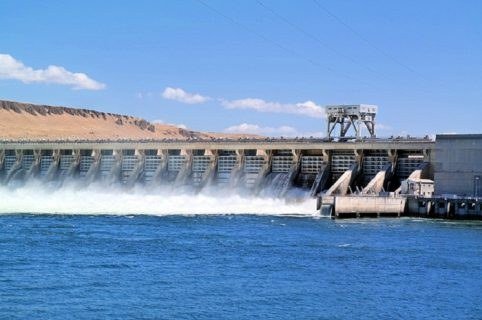
A 30% Jump in National Capacity, On Paper
The numbers are, by any regional standard, extraordinary. At 3,050 megawatts, Mambilla would be Nigeria’s single largest power station, larger than any existing hydro or thermal plant on the grid today. Sited on the Donga River in Taraba State, the “run-of-river” scheme would draw water through 33 kilometres of tunnels before a 1,000-metre drop into two underground powerhouses, spinning twelve 250 MW Pelton turbines.
Translated into annual output, the plant would generate somewhere between 4.7 and 5.5 billion kilowatt-hours of electricity a year, low-carbon, baseload power that doesn’t fluctuate with fuel supply the way Nigeria’s gas-fired plants do. Set against a national grid whose effective generation capacity has hovered stubbornly in the 4,000–5,000 MW range for years despite over 13,000 MW of installed (largely unavailable) capacity, an additional 3,050 MW of reliable hydro power would represent close to a 30% increase in what the grid can actually deliver on a given day. For a country where load-shedding, industrial self-generation, and diesel dependence remain the norm rather than the exception, that scale of addition is both a structural and incremental feat.
| Metric | Figure | Grid capacity implication |
|---|---|---|
| Installed Capacity | 3,050 MW | Nigeria’s single largest power station; ~30% of current effective national grid capacity |
| Annual Generation | 4.7–5.5 bn kWh | Steady, low-carbon baseload output, largely insulated from gas-supply and fuel-price volatility |
| Required New Transmission | ~700 km | Evacuation lines via Jalingo and Makurdi, a precondition for the capacity to reach load centres |
| Financing Structure | 85% China EXIM / 15% FGN | Disbursement and construction timelines hinge on continued clarity on this structure |
Fifty Years in the Making
None of that potential arrived overnight. Mambilla’s origins trace to a 1972 feasibility study on the Donga River’s hydroelectric promise, and for three decades afterward the project existed largely on paper, revisited periodically in national power plans but never carried to contract, as successive governments chose faster-to-build thermal and gas plants over a capital-intensive hydro scheme with a long construction runway. It was Nigeria’s return to civilian rule in the early 2000s that put Mambilla back on the table in earnest.
In 2003, a memo on the project moved through the Obasanjo administration via the then Minister of Power and Steel, Olu Agunloye, and a Build, Operate, and Transfer agreement was subsequently awarded to Sunrise Power and Transmission Company Limited, a Nigerian-registered developer. That award is the origin of the dispute that still shadows the project today, and former President Obasanjo has since disputed its legitimacy in public terms: in testimony and correspondence to the Ministry of Justice and the EFCC, he has maintained that he never approved a contract award to Sunrise, that he had only directed Agunloye’s memo to the Federal Executive Council for discussion, and that he in fact ordered the memo withdrawn in favour of competitive bidding, only for the award to Sunrise to proceed regardless. Agunloye has faced EFCC investigation over the award; he denies wrongdoing, and the matter remains before the courts.
Subsequent administrations moved in a different direction, without ever formally resolving that early dispute. In 2007, the Federal Government awarded a contract for the project to China’s Gezhouba Group Company (CGGC); the engineering design was finalised in 2012, scaling the project to its current 3,050 MW specification; and in November 2017, the Federal Executive Council approved a full Engineering, Procurement, and Construction contract for a consortium of three Chinese state-owned firms, CGGC, Sinohydro, and CGCOC Group, backed in principle by China EXIM Bank financing on an 85/15 split with the Nigerian government. Because the 2003 Sunrise agreement had never been formally terminated or settled, the 2017 award created two competing, unresolved claims to the same project, and that overlap is what froze the financing Mambilla depends on: China EXIM Bank has made continued disbursement contingent on the dispute being cleared. Sunrise Power took its claim to international arbitration at the International Chamber of Commerce (ICC) in Paris, and that arbitration has run for years, cited repeatedly by Chinese lenders as the precondition blocking disbursement. For GridIQ’s purposes, its relevance here is less about the legal specifics than the practical effect: as long as ownership and contractual clarity over the project stayed contested, capacity delivery stayed theoretical rather than actual.
The governance overhang around Mambilla is not confined to that founding dispute, either. In May 2026, a Nigerian court convicted Saleh Mamman, who served as Minister of Power between 2019 and 2021, on twelve counts of fraud and money laundering involving ₦33.8 billion in funds earmarked for the Mambilla and Zungeru hydroelectric projects, a conviction unrelated to the original 2003 award, but one that has reinforced, for many observers, just how much of Mambilla’s fifty-year delay owes to governance failure as much as to legal or financing gridlock.
The Capacity Question Nobody Asks: Can the Grid Absorb It?
But raw megawatts are only half the story, and arguably the less difficult half. Nigeria’s Transmission Company of Nigeria (TCN) network was not built with a single 3,050 MW injection point in mind, and Taraba State sits at the periphery of the national grid rather than at its centre.
Delivering Mambilla’s power to where demand actually exists, the Lagos, Abuja, Kano, and Port Harcourt load centres of this country, will depend on roughly 700 kilometres of new transmission infrastructure routed through Jalingo and Makurdi. Without that evacuation infrastructure built in lockstep with the generation asset, Nigeria would face the paradox already familiar from other stranded-capacity episodes on its grid: gigawatts of power available at the plant gate with nowhere to go. The Siemens-backed Presidential Power Initiative, which targets transmission and distribution bottlenecks nationally, becomes not a parallel initiative but a precondition for Mambilla to matter at all.
There is a second absorption question, less discussed but equally material: can Nigeria’s distribution companies (DisCos) and end-use market actually take on 3,050 MW of new supply? Nigeria’s power sector has a documented history of generation capacity outstripping the grid’s willingness or ability to distribute and collect revenue for it, the so-called “collection gap” that has left gigawatts of already-built thermal capacity underutilised. Mambilla’s baseload characteristics make it more valuable than intermittent renewables in this respect, since it can anchor industrial offtake and support round-the-clock manufacturing in a way solar cannot, provided a bankable offtake agreement and tariff structure exist to move the power from generation to paying customer.
Baseload Power as an Industrial Catalyst
The case for Mambilla’s capacity impact is strongest when framed around what steady, low-cost baseload power can enable rather than simply how many megawatts it adds. Nigeria’s power-constrained industrial base, cement, steel, textiles, agro-processing, has for years priced its own captive diesel and gas generation into production costs, a drag that economists estimate constrains national GDP growth by 2–4% annually. A large, dependable hydro asset changes that calculus in a way that marginal thermal additions do not, because hydro’s operating costs are largely fixed once the dam is built, insulating industrial users from the fuel-price volatility that plagues gas-fired generation.
This is also where Mambilla’s timing intersects with Nigeria’s broader energy transition conversation: 3 GW of renewable baseload materially improves the grid’s generation mix, reducing the country’s reliance on gas supply, itself an intermittent constraint on domestic power plants, while also supporting Nigeria’s stated decarbonisation commitments.
What Still Needs to Be True
None of this capacity potential is self-executing. Three conditions determine whether Mambilla’s 3,050 MW translates into real capacity gains for Nigerian consumers and industry, or becomes another underused asset on a strained balance sheet:
- Legal and financing clarity. The project’s underlying financing structure, 85% China EXIM Bank, 15% Nigerian federal counterpart funding, has long been contingent on resolving the legal disputes that have shadowed the project since competing contracts were awarded in the 2000s and 2010s. Continued clarity and closure on this front is what unlocks disbursement and construction timelines.
- Transmission investment on the same timeline as generation. A phased build-out of the 700 km evacuation network must proceed in parallel with dam construction, not follow it, if Nigeria wants to avoid a repeat of its stranded-capacity problem.
- A credible offtake and tariff framework. Given the scale of the debt being serviced, Mambilla’s power needs paying customers from day one, meaning DisCo readiness and industrial offtake agreements need to be structured well before commissioning, not negotiated afterward.
The Bottom Line for GridIQ Readers
Strip away the decades of politics, and Mambilla’s core proposition for Nigeria’s grid is straightforward: it is the single largest lever available to move the country from chronic capacity shortage toward a genuine baseload surplus, provided the transmission and commercial infrastructure around it receives equal priority to the dam itself. For GridIQ’s readers tracking Nigeria’s electricity sector, the metric to watch is not whether Mambilla is eventually built, the technical blueprint has been complete for over a decade, but whether transmission investment and offtake commitments are being sequenced alongside construction rather than treated as an afterthought once again.
© 2026 GridIQ Analytics and Insight Ltd. Prepared for The Africa Grid Intelligence Report (TAGIR). Figures are drawn from public sources and project disclosures; capacity, cost and financing terms have varied across the project’s history. This piece is an editorial analysis, not investment advice.